Master's Biographies
Walter Schloss
1916 – 2012 · The purest Graham disciple · deep value, by the book
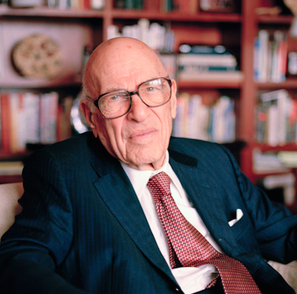 Walter Schloss
He never went to college, and he beat almost everyone who did.
Walter Schloss applied Benjamin Graham's method more faithfully, and for longer, than perhaps anyone alive. No meetings with management, no forecasts, no stories — only the numbers, a margin of safety, and patience measured in decades.
Working from a borrowed closet of an office with a single employee — his son — he compounded his partners' money at roughly fifteen percent a year for nearly half a century. Warren Buffett held him up as living proof that value investing works.
1916
Born in New York
Walter Schloss was born in New York City to a family of modest means. There was no money for university; at eighteen, in the depths of the Depression, he went to work on Wall Street as a runner — carrying securities between brokerages for a few dollars a week.
1934
A runner on Loeb, Rhoades
He started at the bottom at the brokerage Carl M. Loeb & Co. A director there gave him a piece of advice that changed his life: read a new book by a man named Benjamin Graham. The book was Security Analysis.
1938
At the feet of Graham
Schloss enrolled in the evening courses Graham taught at the New York Stock Exchange Institute, learning the discipline directly from its author. The lesson that stuck was the simplest and the hardest: buy a dollar's worth of assets for fifty cents, and let arithmetic, not emotion, decide.
1941–1945
The war years
Schloss served in the U.S. Army during the Second World War, much of it in the Signal Corps. The market, and Graham, would be waiting when he came home.
1946
Graham-Newman
After the war Graham hired him as an analyst at the Graham-Newman partnership, where a young Warren Buffett would soon sit a few desks away. For nine years Schloss hunted for the cheap, unloved, statistically safe situations that were the firm's stock-in-trade.
1955
On his own
When Graham wound down the partnership, Schloss opened Walter J. Schloss Associates with a handful of investors and a few hundred thousand dollars. He took no management fee — only a share of the profits — and so ate only when his partners did.
1955–2000
The method, unchanged
His tools were a copy of Value Line, the Standard & Poor's stock guide, and a telephone he rarely used to call companies. He bought stocks trading below book value or net working capital, held a hundred at a time to spread the risk, and almost never visited a management. Cheapness, diversification, and time did the work.
1973
A family firm
His son Edwin joined him, and for the rest of its life the firm was essentially two men, a ledger, and an unshakeable temperament — frugal to the point of legend, working from a small space sublet from another investor.
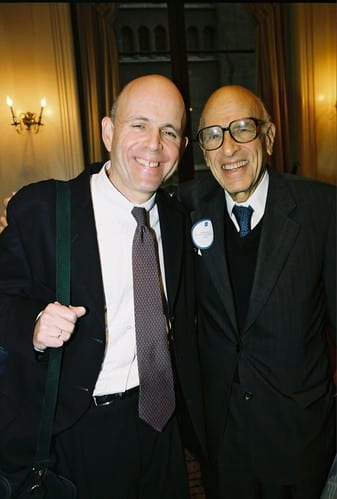 Walter Schloss
1984
A Superinvestor of Graham-and-Doddsville
In a now-famous Columbia address, Warren Buffett named Schloss among the "Superinvestors" whose long records refuted the efficient-market theorists. Buffett noted that Schloss owned hundreds of stocks, knew no inside information, and simply followed Graham — and won.
2002
Closing the books
After more than four decades, Schloss returned his partners' capital and stopped managing outside money. His record across the life of the partnership compounded at roughly fifteen percent a year, comfortably ahead of the market, through every kind of storm.
2012
A quiet end
Walter Schloss died in 2012, aged ninety-five. He left behind no exotic theory and no empire — only one of the longest, cleanest demonstrations that Graham's plain idea, applied with discipline, is enough.
“I'm not very good at judging people. So I found that it was much better to look at the figures rather than people.”
— Walter Schloss
Image credits & copyright
Freely-licensed photographs of Walter Schloss are scarce. Each image below belongs to its respective owner and is used here for educational and editorial purposes; where no free portrait exists, none is shown, in keeping with the standard set on the Benjamin Graham page.
- Walter Schloss photographs — Portrait and the photograph with his son Edwin — © their respective owners; reproduced at modest resolution for identification and educational / editorial commentary.